


Dear Meg: It can seem that way—especially when the red wine is from a warm area and has a core of ripe berry flavor (which can seem sweet). In addition, red wine tends to be lower in acidity than white wine, again leading to an impression of sweetness. But the perception of sweetness is just that—perception. Fine red table wines are actually not sweeter than white wines. In fact, neither red nor white table wine is sweet (i.e. they do not contain a perceptible amount of sugar). For the most part, the only wines that are actually sweet are sweet dessert wines (like Sauternes for example), and some inexpensive wines intended for wine drinkers who like sweet mellow wines.
—Karen
Dear Harvey,
Neither is true. Chianti and Chianti Classico come from two different wine regions within Tuscany, Italy, and each make different wines. While it’s true that both Chianti and Chianti Classico are made primarily from the same great Italian red grape Sangiovese, each regions’ soils (and laws concerning yields and aging) are different, leading to different characters in the wines. In Chianti Classico, the “Classico” refers to the original small area where Chianti was historically made. Chianti (no Classico) is a bigger area, but still a place where some fine wines are made. In both cases, I’d go for the Riserva versions which have more depth and flavor.
Dear Russell,
Unfiltered wine skips the mechanical filtration process that can be used to remove yeasts, microbes, and sediments naturally found in wine. Instead, the wine simply rests for a period, allowing gravity to settle particles before the clear wine is drained off. Some winemakers (and consumers) believe that filtration—especially a “tight” filtration—can strip away nuances of flavor and aroma. Unfiltered wines appeal to these individuals. It should be noted, however, that many unfiltered wines don’t say “unfiltered” on the label. That’s because winemakers often decide on a wine-by-wine basis whether or not to filter certain wines in certain years, and labels may have been printed before the winemaker decides!
—Karen
Dear Kelsey, Good question! No one knows why, of all fruits, only grapes make great wine. And there’s a corollary idea that’s equally perplexing: If you ferment apricots or cherries, or blueberries, the resulting “wine” still tastes like those fruits. But wine made from grapes doesn’t taste like grapes. It can taste like a hundred other things from lemons to cowboy boots, but it almost never tastes like grapes themselves.
—Karen
Hi Caroline. In a word: no. Sugar in grapes is converted into alcohol by yeast, generally leaving less than a trace in the wine itself. The idea that wine contains a lot of sugar is a falsehood that’s nonetheless gotten some traction of late. I’m not sure why. The one exception to my “no” is dessert wine which is intended to be sweet. There are four main different ways that sweet wine can be made—the simplest of which is to stop the fermentation before all of the sugar in the grapes is converted to alcohol. If you happen to have a copy of The Wine Bible, I described the ways sweet wine can be made in detail there.
—Karen
Dear Kayleigh:
Coteaux Champenois is still Champagne. (There are no bubbles). It’s the way Champagne was before it began to be made as a sparkling wine in the 18th century. Coteaux Champenois can be white, rosé, or red. Coteaux Champenois red, which is becoming popular in the US, is often made 100% from Pinot Noir. As such, it’s rather like the basic red wines of Burgundy which are made from vineyards that aren’t that far away.
Hi Matt,
Yes, it can. Certain flavors are associated with coolness even if the entity in question is at room temperature. For example, spearmint, cucumbers, lemons, and menthol are all usually perceived as having a cooling character, even if they are not actually cool temperature-wise. Similarly, but at the opposite end of the scale, baked fruit flavors can seem warming. A wine with baked cherry flavors can seem “warmer” than a wine with crunchy fresh cherry flavors (which can seem cool), even if both wines are the same temperature. This is why certain red wines can be described as “cooling” even though the wine itself has not been chilled.
Dear Paul, This is a great question. And the answer is no; flavor does not need to follow exactly from aroma. Interestingly, many of the greatest, most complex wines in the world have aromas that make you think of a certain set of descriptors, but then the flavors will present themselves differently. It’s why both smelling and tasting a wine is important. By doing both you get a more comprehensive understanding of the wine.
—Karen
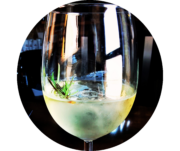
Dear Chenglei, Some of the most delicious vermouths are hand-crafted, artisanal products made by small producers who sometimes use locally sourced botanicals, herbs, spices, and fruits in their own (often secret) recipes. This means that vermouths can vary enormously, while still retaining a recognizable combination of vividly bitter, sweet, and savory flavors. Traditionally, Moscato was used as the base wine, but producers are now using a range of wines, from Pinot Noir to Gewürztraminer. Look for small producers, like MATTHIASSON and UNCOUTH VERMOUTH from the U.S.; LA COPA from Spain; and BERTO and CARPANO “Antica Formula” from Italy.
—Karen
Dear Triana, Apparently it does not. We could not find any scientific data suggesting that swirling in one direction is better (or even different) than the other. What IS important is that you swirl period. All wines—whites, reds and rosés—“open up” and seem more vivid after being mixed with air. The best way to swirl vigorously (and avoid a dry-cleaning bill at the same time) is to draw quick circles with the glass while keeping the foot of the glass on the table.
—Karen
Hi Stan, Many people serve an old wine last as the crowning moment of an extraordinary evening. But most wine pros would serve an old wine first. Older wines usually have more delicate, understated flavors. If you serve an old wine after a younger (and therefore more robust) wine, chances are it will simply end up tasting thin, weak, and uninteresting by comparison. That would be a shame. So, far from being the crescendo of an evening, an older wine should be the sensational opening act.
—Karen
Dear Miranda, Our Business Manager (and ex-sommelier) Tiffany does this too. By coating the insides of the wine glass with the wine, there’s more surface area from which aromas can emanate, amplifying the wine’s flavor. Because most wine glasses have a convex shape, there’s little chance of spilling the wine if you do this carefully. For my part, I like to coat the inside of the glass by vigorous swirling, but both techniques work.
—Karen
Hi Martin: Strictly speaking, they are flavors. Tastes and flavors are The following content is accessible for members only, please sign in.